

In the evolving landscape of global geopolitics, few intellectual figures have captured public attention as rapidly as Professor Jiang Xueqin. The Chinese-Canadian historian and educator, a graduate of Yale University, has become widely known for his unconventional analytical framework known as “Predictive History.”
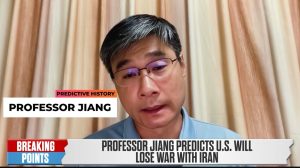
Originally recognized for his work in educational reform in China, Jiang spent much of his early career advocating for creativity, critical thinking, and global citizenship in school systems. However, his influence expanded dramatically when he began publishing lectures online through his project Predictive History, a platform that applies historical patterns and game theory to modern geopolitical developments.

The foundation of Jiang’s approach lies in the belief that historical processes follow recurring structural patterns. According to his analysis, major geopolitical events are rarely random. Instead, they emerge from the interaction of economic pressures, strategic incentives, cultural narratives, and long-term historical cycles.
Jiang’s global recognition accelerated after a lecture recorded in 2024 resurfaced online and went viral. In that lecture, he outlined three bold predictions about global politics: the return of Donald Trump to the U.S. presidency, the escalation of tensions between the United States and Iran, and the possibility that such a conflict could fundamentally reshape global power dynamics.

What distinguishes Jiang’s analysis from conventional geopolitical commentary is his emphasis on civilizational resilience. Rather than focusing solely on military capabilities or political leadership, he studies the structural durability of societies. In his framework, geography, culture, and economic sustainability often determine the long-term outcomes of conflicts more than short-term tactical advantages.
Critics argue that such predictions risk oversimplifying complex political realities. Nevertheless, supporters believe Jiang’s work represents a creative attempt to revive a long-standing intellectual ambition: using historical data to anticipate the future behavior of large societies.
This ambition closely resembles the concept of psychohistory, a fictional discipline developed by science-fiction author Isaac Asimov. While Asimov imagined psychohistory as a mathematical science capable of predicting mass behavior, Jiang presents Predictive History as a practical analytical model grounded in historical case studies and strategic reasoning.
Whether or not his predictions ultimately prove correct, Jiang Xueqin’s growing global audience suggests that there is a strong appetite for new frameworks capable of explaining an increasingly unpredictable world.
Leave a Reply