
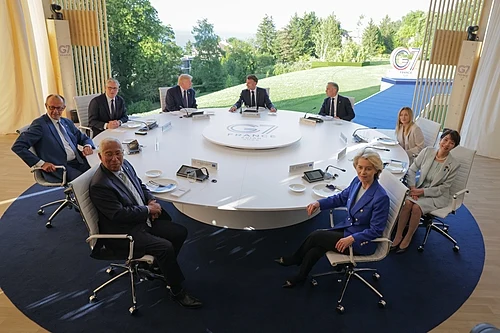
G7 leaders demand a ceasefire in Lebanon and welcome the U.S.-Iran deal, but questions remain over the terms of the agreement and Israel’s position.
Chapter One: A Breakthrough Under Trump’s Leadership
Leaders of the G7 countries, meeting in Évian-les-Bains, France, have issued a joint statement calling the preliminary agreement between the United States and Iran a “breakthrough” secured under the “strong leadership of President Trump”. They also demanded a ceasefire in Lebanon and said they will diversify energy supply routes to reduce dependence on the Strait of Hormuz.
The summit gave Trump a chance to present his deal with Iran to major allies: Britain, Canada, France, Germany, Italy and Japan. They mostly share Washington’s concerns about Iran’s nuclear programme, but they never endorsed his decision to go to war.
Chapter Two: A Fragile Truce and Unanswered Questions
The memorandum of understanding, yet to be made public, extends a ceasefire announced in April by another 60 days to allow the warring countries to negotiate a permanent truce. However, Trump appears to have achieved little of what he said he wanted at the outset of the war. Iran’s theocratic government remains in place, its stockpile of highly enriched uranium has not been surrendered, its ballistic missile capabilities have not been destroyed, and it has not ended its support for anti-Israel militias like Hezbollah.
Ending the war on such terms could expose Trump to criticism, including from hawks within his own Republican party, ahead of midterm elections in November. One of the biggest questions still hanging over the truce is the fate of Lebanon. Israel invaded Lebanon in March to root out Hezbollah and still occupies a swathe of southern Lebanon. Iran says the ceasefire must also end hostilities in Lebanon, while Israel says it will not withdraw and reserves the right to use military force, opening a rift between Israel and the United States.
Chapter Three: A Coalition to Secure Shipping
Britain and France are set to lead a coalition to help secure shipping once the Strait of Hormuz reopens as expected on Friday. President Emmanuel Macron of France and Prime Minister Keir Starmer of Britain pledged this week to quickly deploy military assets to help ships navigate the Strait.
Sources & References:
-
Reuters – “G7 Leaders Demand Ceasefire in Lebanon, Welcome Iran Deal”, 17 June 2026.
-
The New York Times – “G7 Summit Live Updates: Leaders Praise Trump for U.S.-Iran Deal”, 17 June 2026.
Leave a Reply