
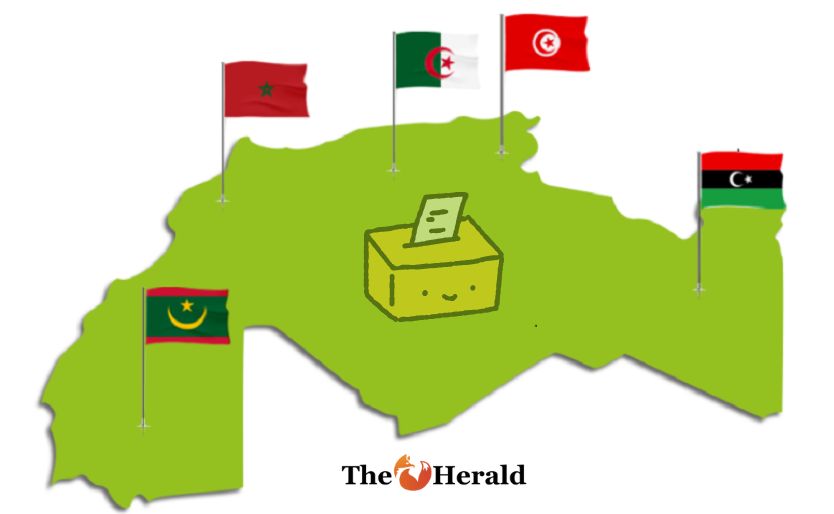
The 2024 elections in Tunisia and Algeria represent critical turning points for the future of these two Maghreb countries, facing internal challenges while being influenced by regional and global dynamics. These elections will also have major repercussions on Morocco, which shares complex geopolitical and economic ties with its Maghreb neighbours.
Tunisia: Democratic Challenges and Economic Challenges
Since the 2011 revolution, Tunisia has tried to maintain its democratic gains, but the 2024 elections are taking place in a context of deep political and economic crisis. President Kais Saied, who monopolized power after the dissolution of parliament in 2021, is seen by some as a guardian of stability, while others see him as a threat to Tunisian democracy.
The 2024 elections are seen by observers as a crucial test for the survival of the democratic system in Tunisia. The political scientist Radwan Masmoudi says: “If Tunisia fails to consolidate its democracy, it could find itself in a spiral of authoritarianism, which would affect not only Tunisia but also the entire Maghreb”. The deteriorating economic situation, marked by high unemployment and galloping inflation, could also play into the hands of populist candidates.
The impact on Morocco would not be negligible. As Tunisia is a trading partner and a regional player, prolonged instability could weaken economic exchanges between the two countries. In addition, Morocco has every interest in Tunisia remaining a stable democratic pole to preserve the regional balance. Analyst Samir Bennis points out: “Morocco is closely following developments in Tunisia, as any destabilization could lead to migration to the region and complicate trade relations in the Maghreb. »
Algeria: Political transition and popular pressure
In Algeria, the 2024 elections were held under the sign of a post-Bouteflika transition marked by incessant social movements. Hirak, a protest movement that emerged in 2019, continues to exert pressure on the regime for more transparency and political reforms. President Abdelmadjid Tebboune, despite his promises of change, is struggling to convince a population distrustful of political elites.
The 2024 elections will be a decisive moment to determine if Algeria can embark on the path of real democratic reforms or if the system in place will continue to dominate. Political scientist Dalia Ghanem says: “Algeria is at a crossroads. Either it adopts far-reaching reforms to meet the demands of the people, or it will continue to suppress social movements, which could lead to prolonged instability. »
For Morocco, the Algerian elections are of strategic importance, in particular because of the persistent bilateral tensions, in particular around the issue of the Moroccan Sahara known as the “Western Sahara Conflict”. If Algeria were to experience a prolonged political crisis, this could intensify rivalries with Morocco, particularly in terms of regional geopolitical alliances. As the expert Mohamed Chtatou points out, “Morocco has an interest in a stable Algeria, but any weakening of the regime could lead to a more aggressive posture towards Rabat, especially regarding the Sahara issue”.
Regional and Global Impact: Impacts on Morocco
The elections in Tunisia and Algeria come in a regional context marked by multiple crises, including the war in Ukraine and tensions in the Middle East. These crises indirectly affect the Maghreb, particularly in terms of energy. Algeria, as the main gas exporter, is a key player in the negotiations with Europe, while Tunisia, in economic difficulty, depends on international assistance to stabilize its economy.
For Morocco, the elections in these two neighboring countries represent an opportunity and a threat. Economically, Morocco could strengthen its role as a stable regional power, attracting foreign investment to an increasingly uncertain Maghreb. However, a deterioration in relations with Algeria, which could result from an unstable political transition, would threaten Morocco’s ambitions to position itself as a regional leader.
Therefore, the 2024 elections in Tunisia and Algeria are of paramount importance not only for these two countries, but also for the entire Maghreb and more broadly for the world stage. Morocco, although relatively stable, must adapt to these constantly changing dynamics. As historian Benjamin Stora writes, “The future of the Maghreb lies in the delicate balance between national ambitions and regional tensions, where each country plays a crucial role. The results of these elections will largely determine the geopolitical configuration of the region in the coming years.
Leave a Reply