
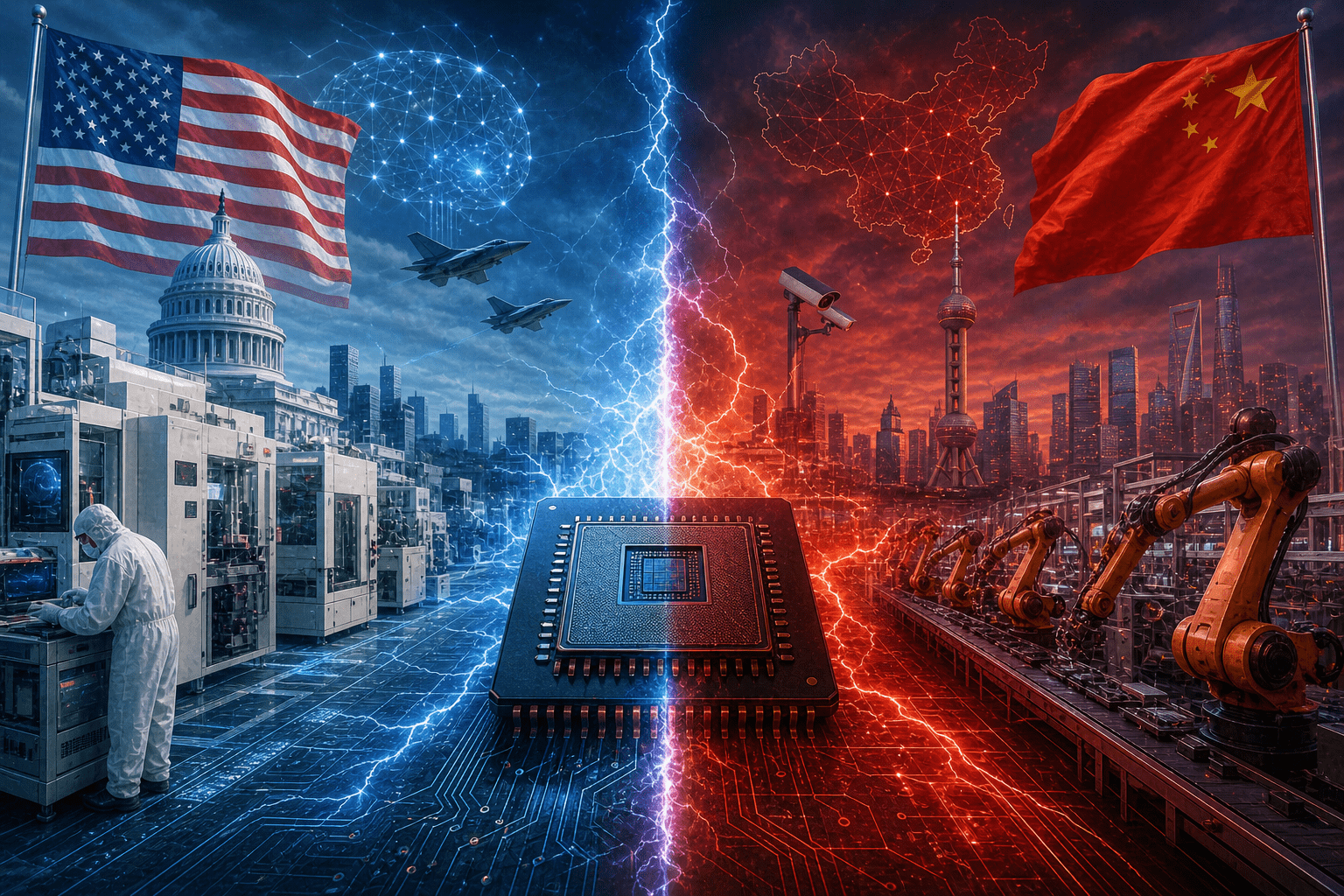
For decades, the semiconductor industry operated under a quiet but effective consensus: Taiwan would manufacture the most advanced chips, the United States would design the architectures, China would assemble the final products, and the rest of the world would buy the results. That era ended abruptly in 2025 when Washington imposed its most aggressive export controls to date, banning not only the sale of advanced artificial intelligence chips to China but also the equipment needed to manufacture them. Now, in May 2026, we are witnessing Chip Wars 2.0 – a full-blown technological decoupling that threatens to fragment the global economy into two separate and potentially incompatible tech ecosystems: one led by the United States and its allies, and another led by China.
Three major events have accelerated this conflict beyond all previous forecasts. First, Chinese state-backed firm SMIC successfully produced a functioning 3-nanometer chip using deep ultraviolet lithography, proving that sanctions alone cannot stop a determined and well-funded innovation machine. Second, the Trump administration, now back in power, designated what it calls “AI sovereignty” as a national security priority of the highest order, pouring over two hundred billion dollars into domestic fabrication plants – or fabs – across Texas, Arizona, and Ohio. Third, the ongoing war in the Middle East has disrupted traditional maritime supply routes, making technological self-reliance a strategic imperative for both superpowers simultaneously. The result is a costly and accelerating race. According to Bloomberg Economics, the full technological decoupling between the United States and China will cost global GDP approximately 1.2 trillion dollars over five years – an economic loss roughly equivalent to wiping out the entire economy of Mexico. Chip prices have already risen by 30 percent since January of this year, affecting everything from smartphones to F-35 fighter jets.
In the short term, the United States still leads in chip design through companies like Nvidia, AMD, and Intel, as well as in advanced lithography equipment through the Dutch firm ASML. However, China leads decisively in mature-node chips at 28 nanometers and above, which power automobiles, washing machines, medical devices, and military hardware. Neither side can fully replace the other, and this mutual dependency makes the conflict even more dangerous. China has stockpiled critical components, accelerated indigenous research, and deepened technological ties with Russia and Iran – markets that effectively bypass dollar-based sanctions. The result is a bifurcated world already taking shape: two internets, two artificial intelligence standards, and soon two completely separate supply chains that will force multinational companies to choose sides. No one truly wins a trade war, but some lose less than others. The real victim is global cooperation itself – the idea that science and technology belong to all humanity. As we build higher walls, we may also build higher silos of ignorance.
Leave a Reply