
Rabat, May 13, 2026
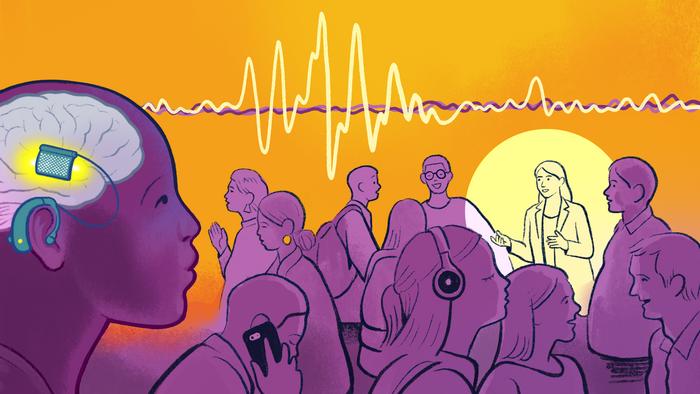
For decades, hearing aids have been guided by a simple, but deeply flawed, premise: louder is better. They amplify all sounds indiscriminately, turning the chaotic noise of a cocktail party, a restaurant or a family gathering into an overwhelming wall of sound. But the brain does not work that way. The healthy human ear can effortlessly isolate a single voice and mute the rest – a remarkable ability known as the “cocktail party effect.” Now, for the first time, a team of neuroscientists and engineers at Columbia University’s Zuckerman Institute has succeeded in replicating this biological talent in real time, creating a brain‑controlled hearing system that literally reads the listener’s mind to amplify only the voice they choose to hear.
Published today in the journal Nature Neuroscience, the breakthrough represents a radical departure from conventional hearing aids. Instead of amplifying everything equally, the device acts as a “neural extension” of the user. It decodes the brain’s own attentional signals and automatically turns up the volume of the attended speaker while quieting all other voices, in real time.
“We have developed a system that acts as a neural extension of the user, leveraging the brain’s natural ability to filter through all the sounds in a complex environment to dynamically isolate the specific conversation they wish to hear,” said Nima Mesgarani, PhD, the paper’s senior author and a principal investigator at Columbia’s Zuckerman Institute.
The study, which took more than a decade to complete, finally bridges the gap between laboratory theory and real‑world application. For the first time, researchers have direct, empirical evidence that a closed‑loop, brain‑controlled hearing aid can provide a clear, immediate perceptual benefit to human listeners in a multi‑talker environment.
How It Works: Reading Attention From the Brain
To build the system, the Columbia team partnered with epilepsy patients who were already undergoing intracranial monitoring to pinpoint the sources of their seizures. These volunteers had electrodes temporarily implanted in their brains, which gave the researchers direct, high‑resolution access to the neural signals involved in selective attention.
In a series of experiments, the participants listened to two overlapping conversations played simultaneously. As they shifted their focus from one speaker to the other, a custom‑designed machine‑learning algorithm analyzed their brainwaves in real time. Within milliseconds, the system identified which conversation the listener was attending to and automatically adjusted the audio – boosting the volume of the target speaker while suppressing the competing voice.
The system’s performance was remarkably fast and accurate. It correctly tracked both instructed attention shifts (when researchers told the participant which voice to follow) and self‑initiated shifts (when the participant freely chose which conversation to listen to). The result was a dramatic improvement in speech intelligibility, a measurable reduction in listening effort, and a consistent preference for the brain‑controlled system over the un‑assisted condition.
“For the first time, we have shown that such a system that reads brain signals to selectively enhance conversations can provide a clear real‑time benefit. This moves brain‑controlled hearing from theory toward practical application,” said Vishal Choudhari, the study’s first author, who led the development and evaluation of the system.
The “Cocktail Party Problem” – An Enduring Challenge in Neuroscience
Why is this breakthrough so significant? Because the inability to isolate a single voice in a noisy environment – a phenomenon audiologists call the “cocktail party problem” – is one of the most frustrating and persistent challenges for people with hearing loss, and even for normally hearing individuals in loud spaces.
Conventional hearing aids excel at reducing steady background noise, such as traffic or air conditioners. But they are fundamentally “dumb” devices: they cannot infer the listener’s intent. When multiple people are speaking at once, they amplify all voices equally, producing a jumbled, stressful mix that often drives users to simply turn the device off and retreat into silence.
The Columbia team’s approach is fundamentally different. It leverages the fact that the human auditory cortex already produces a distinct neural signature for the attended speaker. By reading this signature, the device bypasses the need for guesswork. It does not simply amplify sound; it amplifies the sound the listener actually wants to hear.
“This science empowers us to think beyond traditional hearing aids, which simply amplify sound, toward a future where technology can restore the sophisticated, selective hearing of the human brain,” Dr. Mesgarani said.
A Decade of Progress, One Leap Forward
The journey to this breakthrough began more than a decade ago. In 2012, Dr. Mesgarani and his colleagues first demonstrated that specific patterns of brain activity could reveal which conversation a person was focusing on and which they were filtering out. Over the following years, they overcame a host of engineering challenges: they developed algorithms to automatically separate multiple overlapping voices, and then learned to compare the acoustic properties of each speaker to the listener’s brainwaves in real time.
The central unanswered question – whether a closed‑loop, real‑time system could actually improve hearing, rather than merely track attention – has now been definitively answered. The Columbia team’s prototype meets the key performance benchmarks required for a practical auditory brain‑computer interface, establishing a foundation for future wearable devices that could be used outside the laboratory.
One volunteer’s response to the system was so immediate and intuitive that she accused the researchers of secretly adjusting the volumes themselves. Others, moved by the experience, immediately began sharing stories of friends and relatives with hearing impairments, imagining how their lives could be transformed.
“It seems like science fiction,” one participant said.
The Bigger Picture: From Hearing Aids to Neural Augmentation
The implications of this research extend far beyond improved hearing aids. According to the World Health Organization, more than 430 million people worldwide live with disabling hearing loss – a number that is rising rapidly as populations age. Untreated hearing loss is not merely an inconvenience; it is a leading modifiable risk factor for dementia, and a primary contributor to depression and social isolation.
But the ultimate promise of brain‑controlled hearing technology is even broader. The same principles could one day be applied to augment the hearing of normally hearing individuals in challenging environments: helping a surgeon focus on a single monitor in a busy operating theater, allowing a student to tune into a lecturer’s voice in a noisy classroom, or letting a parent hear their child’s voice at a crowded birthday party.
“Can you imagine if this technology existed in a world … where he could access it?” one volunteer said, recalling her uncle with severe hearing loss. “He might actually live a much more peaceful … life.”
What Comes Next
The researchers caution that a great deal of work remains before this technology is ready for everyday use. Current prototypes rely on invasive, implanted electrodes, which are not practical for most users. The next major hurdle is to develop a minimally invasive, wearable version – perhaps using non‑invasive electroencephalography (EEG) caps or other advanced sensing technologies – that can function reliably in more complex, real‑world scenarios.
Nonetheless, the fundamental principle has been proven. The human brain’s natural ability to filter sound can be read, decoded, and mirrored by a machine in real time, providing a tangible benefit to the listener. After more than a decade of foundational research, the world’s first brain‑controlled selective hearing system has arrived. It is not yet in your ear, but it is no longer a question of if – only of when.
“The results mark an important step toward a new generation of brain‑controlled hearing technologies that align with the listener’s intent, potentially transforming how people navigate noisy, multi‑talker environments,” Dr. Choudhari said.
Sources & References
Choudhari, V., Nentwich, M., Johnson, S., et al. (2026). Real‑time brain‑controlled selective hearing enhances speech perception in multi‑talker environments. Nature Neuroscience. DOI: 10.1038/s41593‑026‑02281‑5
Columbia University’s Zuckerman Institute (2026, May 11). Brain‑controlled hearing system proves itself in first human studies. EurekAlert!
Mesgarani, N., et al. (2012). A brain‑controlled hearing aid that decodes who you want to hear. Nature Neuroscience. (Foundational study)
World Health Organization. (2026). Deafness and hearing loss. WHO Fact Sheets.
Leave a Reply