
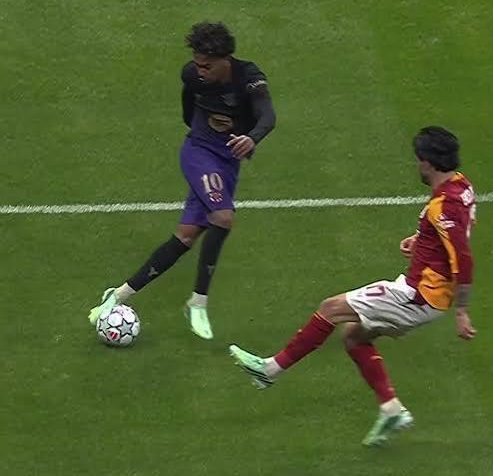
On the night of October 13, 2026, at Galatasaray, it wasn’t Anthony Gordon’s third goal that set social media ablaze—it was the touch before it. Lamine Yamal, Barcelona’s teenage sensation, used a “fake rabona” to glide past defender Eren Elmali and set up the decisive goal. The moment was immediately hailed as a new tactical icon, while reigniting a global debate over the origins of the skill.
Anatomy of the move
A traditional rabona involves kicking the ball with one leg wrapped behind the other, usually to cross or shoot. Yamal, however, didn’t use it to pass—he used it to dribble. He shaped as if about to attempt a rabona, then at the last second, dragged the ball back with his left foot behind his right leg, leaving the defender frozen. This hybrid of rabona and elastico created a moment of cognitive delay for the defender, who couldn’t read the attacker’s intention. Yamal explained: “I’d noticed lately that when I get to the byline, defenders throw themselves to the ground, and I saw an opportunity. I thought I could pull it off. It’s prettier, and it worked.” He added: “I always try to use feints to create space because defenders try to get close to me.” He dubbed the move the “304,” a nod to the postal code of Rocafonda, the neighborhood where he grew up.
Why it matters tactically
In modern football, where spaces are tight and defenders are faster, you need an unexpected trick to create room. The fake rabona creates perceptual hesitation: it makes the defender believe the ball will come from one direction while it arrives from another. As Yamal put it: “I always try to create space.”
Who “invented” it?
After the match, some pundits rushed to crown Yamal as the “inventor” of the move. But Argentine coach Claudio Borghi poured cold water on the European enthusiasm, insisting that Chilean playmaker Matías Fernández was executing a similar maneuver nearly two decades ago, known as the “Mati-Rabona.” Borghi said: “The first time I saw that was with Matías… A lot of people think football was born yesterday.” The debate reveals that the fake rabona is not an invention from scratch, but a creative evolution of an existing skill, recontextualized by Yamal.
From a trick to a signature
What Yamal did was more than a fleeting skill—it was a tactical signature that has become part of his footballing identity. In football, the greats don’t merely copy moves; they reinvent them. With this fake rabona, Yamal proved he is not content to be “Messi’s heir”—he is building his own language on the pitch.
Sources :
Diario AS (October 14, 2026). Lamine Yamal explains viral ‘near rabona’ dribble: What does 304 stand for?
Diario AS (October 14, 2026). Lamine se inventa el regate ’304′.
Goal.com (October 14, 2026). Henry left in awe: Yamal reveals the secret of his exceptional dribbling.
La Cuarta (October 15, 2026). Borghi confirma que Mati Fernández inventó el regate que hizo Lamine.
OneFootball (December 18, 2024). The Rabona: A Skillful Move That Embodies Flair in Football.
Associated Press (October 14, 2026). Yamal steals the spotlight with dazzling ‘semi-rabona’ assist.
Leave a Reply