
Abstract:
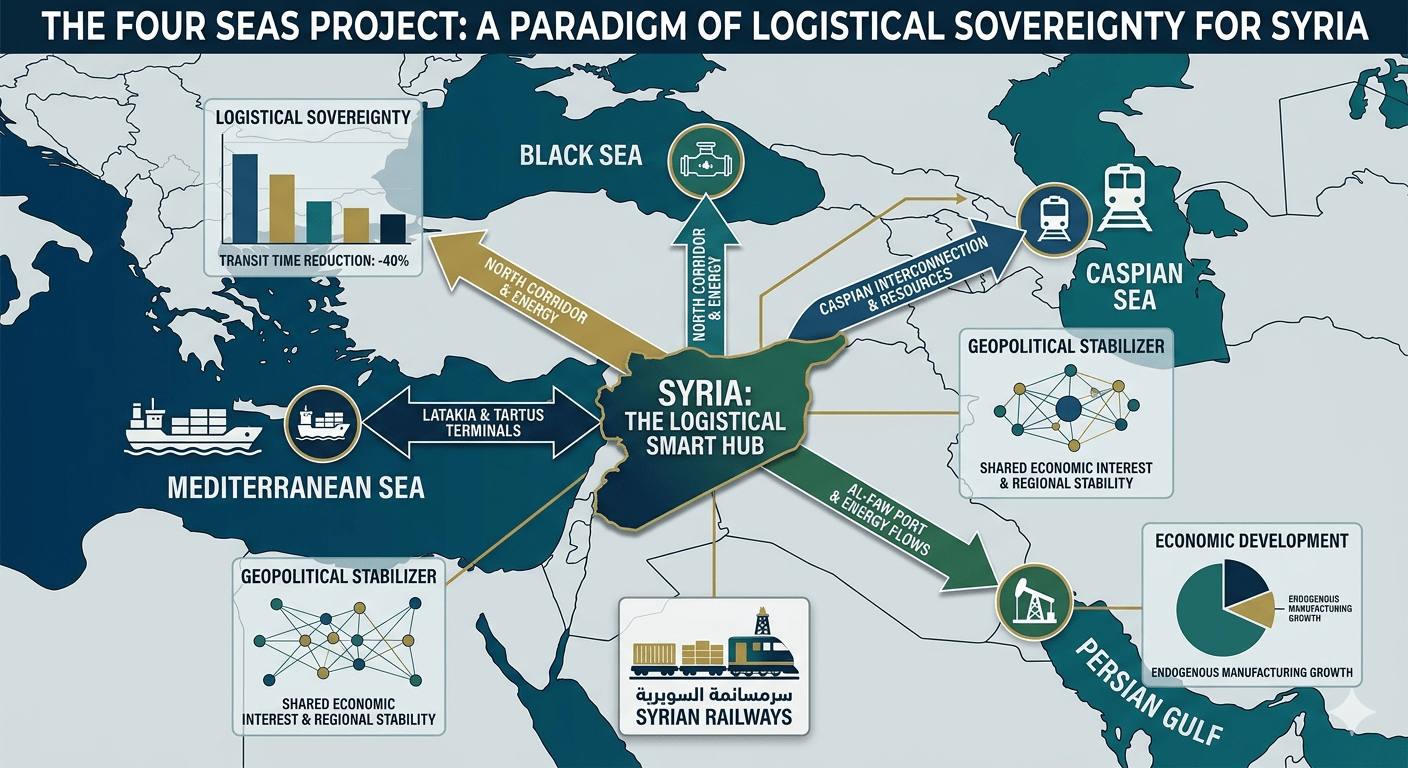
The Four Seas Project stands as the cornerstone of Syria’s national reconstruction doctrine. By leveraging a unique geographical centrality between the Mediterranean, the Persian Gulf, the Black Sea, and the Caspian Sea, this project aims to transform Syria into a multimodal pivot. This analysis examines the geopolitical and macroeconomic implications of this transition toward integrated logistical sovereignty.
Geostrategic Anchoring and the Dialectics of Space
The vision of the Four Seas Project is rooted in an immutable geographical reality: Syria is the only natural land bridge capable of linking the four major hydrographic basins of Western Eurasia. In 2026, within a global system marked by the volatility of maritime routes and the insecurity of chokepoints, Syria seeks to monetize its spatial position. This project is not limited to a simple transit function; it is a strategic attempt to redefine national power through the control of flows. “Logistical sovereignty” thus becomes a tool for active diplomacy, where geography dictates the necessity for a regional consensus surrounding the stability of Syrian territory.
Multimodal Architecture and Intercontinental Connectivity
The operational success of the project relies on the development of a high-capacity transport corridor. The central pivot is the railway junction connecting the Al-Faw port complex in Iraq to the terminals of Latakia and Tartus. This infrastructure, integrated into “Belt and Road” dynamics, allows for a drastic reduction in transit times—up to 40% compared to African circumnavigation. The major innovation of 2026 lies in the integration of “Smart Hubs” using big data processing to optimize cargo movement, making Syria an indispensable and technological link in the security of Eurasian trade.
The Energy Dimension and Geopolitical Stabilizer
Beyond physical goods, the project encompasses a systemic energy dimension. Syria positions itself as a flow regulator for hydrocarbons and electricity between production centers (Caspian and Gulf) and Mediterranean consumption markets. By facilitating transcontinental pipelines, Damascus creates a functional interdependence between often divergent regional actors. This network architecture acts as a “passive stabilizer”: the cost of transit disruption becomes so high for partners that peace becomes the only economically rational option. Energy is thus instrumentalized as a vector for regional pacification.
Macroeconomic Implications and Financing Challenges
Internally, the goal is a transition from a rentier economy to a value-added economy. The project provides for industrial free zones contiguous to logistical axes to encourage in-situ processing of raw materials. This stimulates endogenous growth and offers opportunities for a skilled workforce, thereby stemming the brain drain. However, long-term viability depends on the mobilization of massive international capital (FDI) and a stable legal framework. Reconstructing infrastructure requires a multilateral commitment that transcends current political divides.
Ultimately, the Four Seas Project is a new geopolitical contract proposed by Syria. By aligning its geography with 21st-century connectivity needs, Damascus hopes to transform its territory from a battlefield into a crossroads of shared prosperity. The success of this project will determine Syria’s ability to reclaim its historical role as the heart of the modern Silk Road.
Leave a Reply