


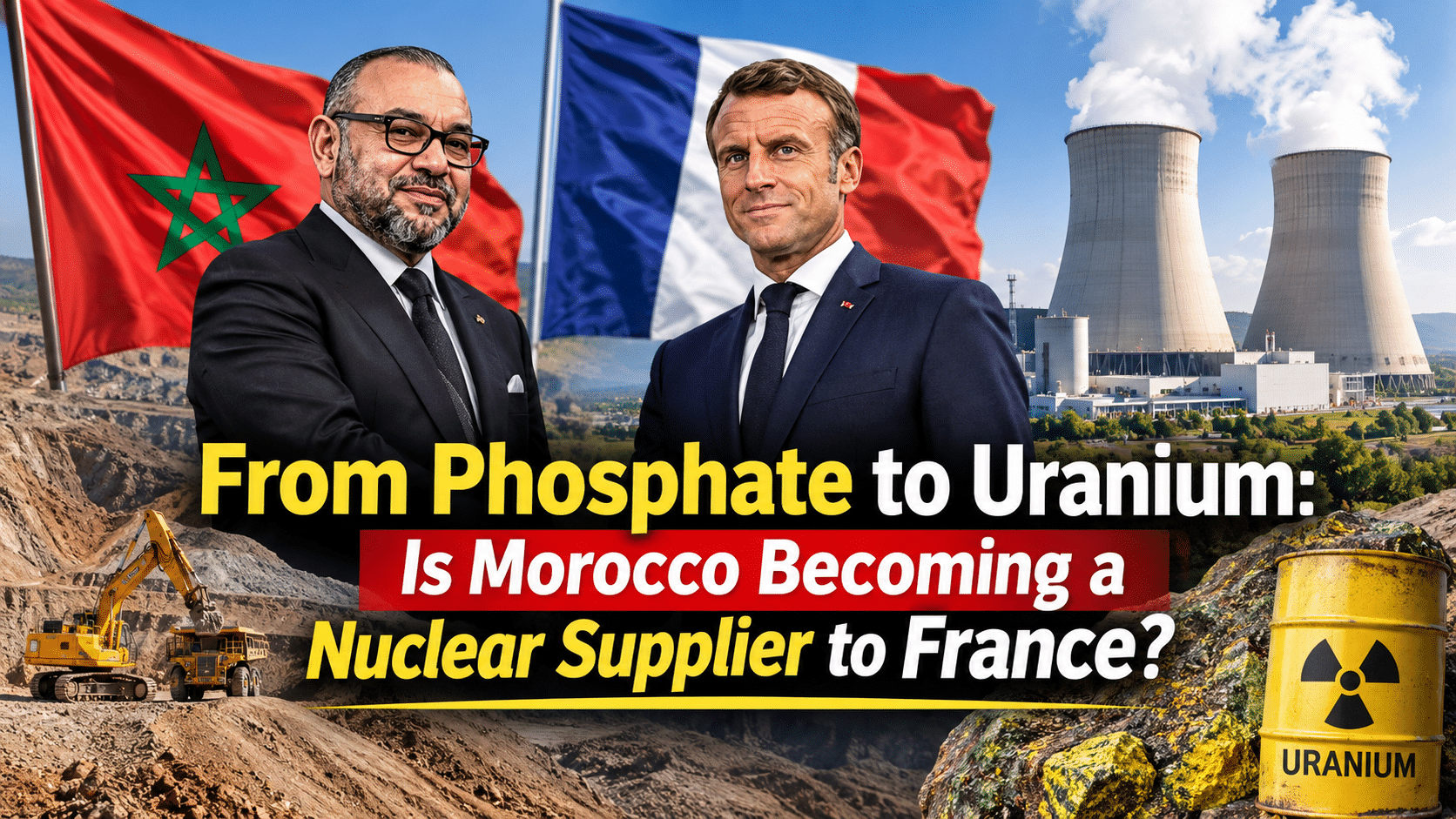
In November 2026, the French newspaper Le Monde revealed advanced negotiations between Morocco’s Office Chérifien des Phosphates (OCP) and French energy companies EDF and Orano, aimed at producing and supplying uranium concentrates (known as “yellowcake”) extracted from Moroccan phosphate, to fuel French civilian nuclear power plants. These talks, which may culminate in the signing of a protocol agreement during King Mohammed VI’s anticipated visit to Paris in January 2027, raise a strategic question: Is Morocco transitioning from a mere phosphate exporter to a player in the global nuclear value chain?
The Hidden Chemistry: How Uranium Emerges from Phosphate
The Moroccan and French interest in this project is not coincidental. Moroccan phosphate rock naturally contains trace amounts of uranium, which transfers to phosphoric acid during the processing of phosphate with acids to produce fertilizers. Modern technologies now allow for the extraction of this uranium as a by-product, creating an additional revenue stream for the phosphate value chain without the need for conventional uranium mines.
The project is not entirely new. A similar attempt was made in 2007 between OCP and the company “Areva” (which later became Orano), but it was halted. The Belgian group “Prayon” had also previously extracted hundreds of tons of uranium concentrates from Moroccan phosphate before operations ceased due to high costs at the time. What has changed today is the global rise in uranium prices, advances in extraction technologies, and the results of a limited production test conducted by OCP, which sources described as “fruitful.”
The French Motivation: Seeking a Strategic Alternative to Niger
France, which relies heavily on nuclear energy for electricity generation, has found itself forced to seek alternative sources of uranium after its relations with Niger deteriorated following the July 2023 military coup, the suspension of its purchases of Nigerien uranium, and then the Nigerien authorities’ takeover of the “Somair” mine operated by Orano in June 2025. Orano has confirmed its commitment to a “strategy of diversifying supply sources,” which explains its interest in Morocco as a new and geopolitically stable partner.
Timeline and Industrial Ambition
According to leaks, industrial operations could begin in 2028, with a plant near the port of Jorf Lasfar on the Atlantic coast, where OCP owns a huge industrial complex for phosphate processing. Morocco’s ambition is not limited to supplying France alone; by 2030, OCP aims to produce quantities of phosphoric acid sufficient to extract uranium equivalent to the needs of around 15 nuclear reactors, potentially opening the door for Morocco to supply the broader European market.
A Civilian Supplier, Not a “Military Nuclear” One
Morocco is not planning to export a “nuclear weapon” or sensitive nuclear technology to France. Rather, it is negotiating to become a supplier of natural uranium (in concentrate form) extracted from phosphate—a primary material in the civilian nuclear fuel cycle. If realized, the project would give Morocco a position in the civilian nuclear value chain and strengthen its standing as a strategic partner for France and Europe in energy security, without making it a state possessing military nuclear technology. The open question remains: Will Rabat succeed in turning “yellowcake” into a new diplomatic and economic asset, or will it settle for the role of silent supplier in a market dominated by the major players?
References
-
Al-Quds Al-Arabi (November 14, 2026). Will Moroccan uranium fuel French nuclear plants? (citing Le Monde).
-
CRU Group (November 18, 2026). France, Morocco in talks for uranium supplies from phosphate processing.
-
Al-Mashhad (November 16, 2026). Moroccan phosphate as a new source of French nuclear fuel: What’s the story?
-
Journal 24 (November 14, 2026). Le Monde: Morocco close to entering the nuclear uranium market.
-
African Economy Inc. / LinkedIn (November 15, 2026). Morocco’s OCP in talks with EDF and Orano.