


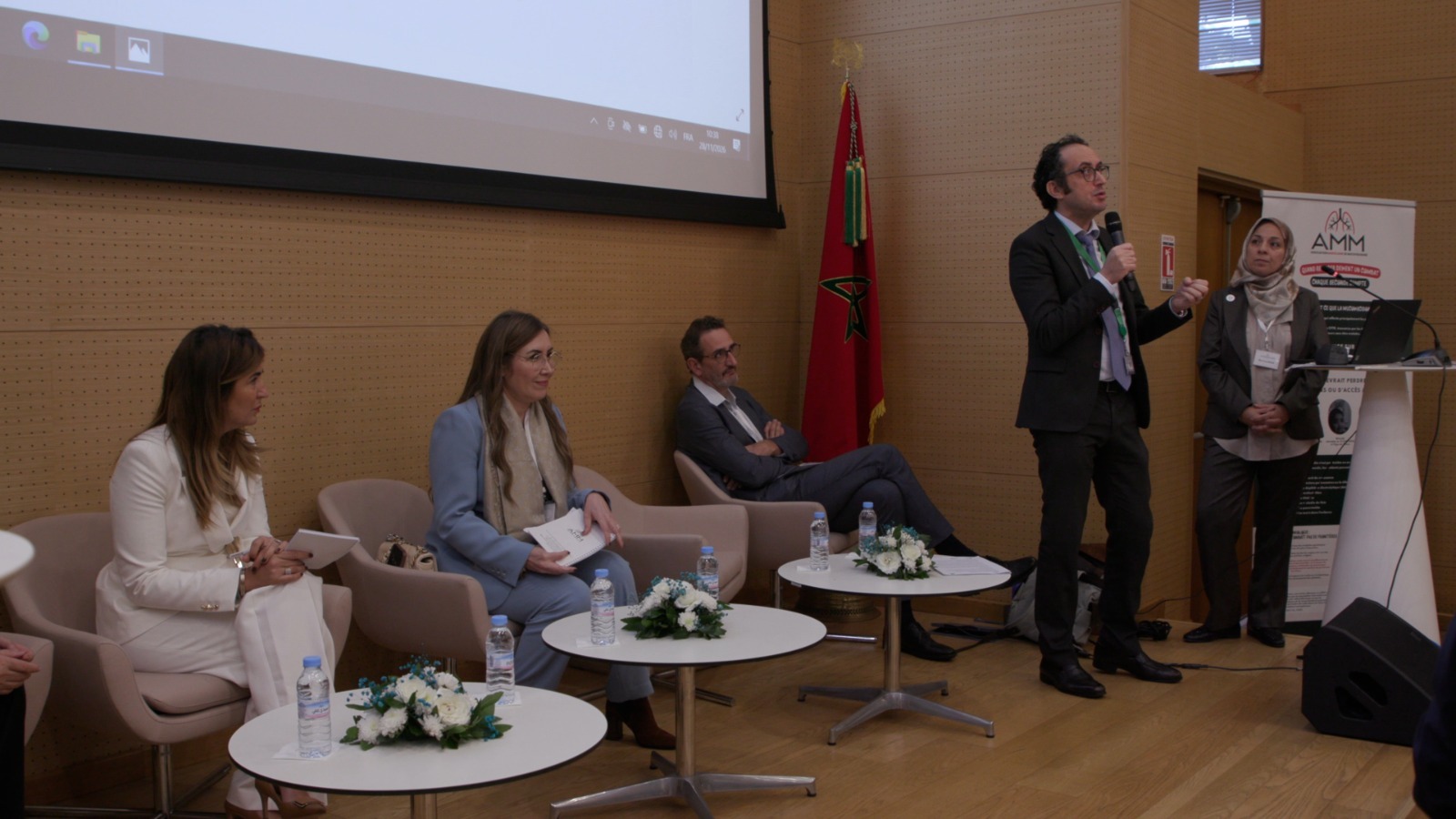
In a step described by civil society actors as “historic,” the Mohammed VI Center for Research and Innovation (CM6RI) in Rabat hosted, on Saturday, November 28, 2026, the third edition of the Franco-Moroccan Cystic Fibrosis Day, under the theme: “Cystic Fibrosis in Morocco: From Early Diagnosis to Access to Innovative Treatments, the Challenge of Equity.” The event was not a mere scientific meeting: it marked a shift in the approach to the disease, materialized by the signing of a joint declaration to structure a national pathway, the launch of a five-year roadmap, and the expansion of neonatal screening to include cystic fibrosis alongside four other diseases. According to the announced data, Morocco is moving for the first time toward integrating screening and treatment into a framework of free care, despite the considerable cost this entails.
The Press Release: “From Early Diagnosis to Access to Treatments”
Below is the full text of the press release from the Moroccan Cystic Fibrosis Association (AMM):
Press Release
Rabat, November 28, 2026
Third Edition of the Franco-Moroccan Cystic Fibrosis Day: Toward Early Diagnosis and Equity in Access to Care in Morocco
The Moroccan Cystic Fibrosis Association (AMM), in partnership with the French association Vaincre la Mucoviscidose (VLM), is organizing on Saturday, November 28, 2026, the third edition of the Franco-Moroccan Cystic Fibrosis Day, at the Mohammed VI Center for Research and Innovation (CM6RI) in Rabat.
The event is held under the theme: “Cystic Fibrosis in Morocco: From Early Diagnosis to Access to Innovative Treatments, the Challenge of Equity,” with the participation of medical experts, researchers, and institutional representatives, to discuss ways to structure a national pathway for the care of cystic fibrosis patients.
Understanding Cystic Fibrosis
Cystic fibrosis is a hereditary genetic disease transmitted in an autosomal recessive manner. It primarily affects the lungs and digestive system, including the pancreas, bile ducts, and liver, as well as the sweat glands and reproductive system. It results from a defect in the CFTR gene, transmitted by carrier parents who may not be affected by the disease. This defect leads to the production of abnormally thick and sticky mucus, causing respiratory problems, chronic lung infections, pancreatic insufficiency, and absorption disorders.
A Strategic Milestone: Signing of a Joint Declaration for a National Pathway
The signing of a joint declaration to structure a national pathway for cystic fibrosis care in Morocco is one of the highlights of this event. This commitment brings together civil society actors, represented by Ms. Fenna Bouyer, President of AMM, and Mr. Thierry Nouvel, Director General of Vaincre la Mucoviscidose, alongside health professionals, represented by Pr. Amal Hassani and Pr. Naïma Amenzoui. The approach is based on a five-year roadmap built around five priorities: improving diagnosis and early screening, identifying patient needs, training health professionals, strengthening awareness and recognition of the disease, and gradually developing a national care network.
High-Level Scientific and Institutional Mobilization
The proceedings were opened in the presence of a representative of the Ministry of Health and Social Protection. Participants included Ms. Kenza Zerrou, representative of the World Health Organization in Geneva, Pr. Saber Boutayeb, Director General of CM6RI, Pr. Amina Barkat, specialist in pediatrics, neonatology and nutrition, Mr. Thierry Nouvel, and Pr. Amal Hassani, Professor of Pediatrics and Colonel Physician at the Pediatric Department of the Mohammed V Military Teaching Hospital in Rabat, specializing in pediatric respiratory diseases, allergies, cystic fibrosis, and rare respiratory diseases in children.
The event is part of a broad institutional partnership including the Faculty of Medicine and Pharmacy of Casablanca (FMPC), the Casablanca-Settat Territorial Health Group, the Military Hospital of Rabat, and CM6RI.

Main Axes of the Scientific Program
Throughout the day, from 8:30 a.m. to 7:30 p.m., Moroccan and international specialists exchange expertise on four main axes: knowledge and genetics (epidemiology, pathophysiology), diagnosis and lifelong follow-up (symptoms in children, transition from pediatric to adult care), treatments and supportive care (symptomatic and innovative treatments, physiotherapy and respiratory rehabilitation), and public health and advocacy (care challenges, national registry, need to accelerate neonatal screening).
Objectives
Ms. Leila Rkhissi, Director of Communication and Development at AMM, presented the objectives of the day: strengthening awareness, supporting families, and improving care for cystic fibrosis in Morocco. These objectives include:
-
Working to recognize cystic fibrosis as a chronic disease requiring long-term care in Morocco;
-
Raising awareness among the public, families, and health professionals;
-
Promoting the creation of a Moroccan cystic fibrosis registry;
-
Facilitating access to neonatal screening and early diagnosis;
-
Supporting and guiding affected families;
-
Contributing to improving access to medicines and healthcare;
-
Encouraging the training of doctors, physiotherapists, nurses, and nutritionists;
-
Developing national and international partnerships to enhance care.
At the close of the event, Pr. Amal Hassani will present the recommendations arising from the discussions, with the aim of accelerating the improvement of the patient care pathway and strengthening recognition of this rare disease in Morocco.
Between Promise and Fulfillment: Where Does Morocco Stand?
The press release contains positive signals but does not hide the scale of the challenges. Until recently, medical reports indicated that cystic fibrosis “is not effectively recognized by the national health system,” depriving patients even of symptomatic treatment. Oral questions in Parliament confirm that the disease “requires considerable material resources,” that “most medicines are not available in national pharmacies,” and that the few available are “very expensive.”
The paradox is that global scientific progress has provided innovative genetic treatments, notably Kaftrio (Trikafta), described by specialized associations as a “revolution” that turns the disease into a stable chronic condition for some patients. However, its annual cost reaches about $370,000** in the US market, while production estimates suggest it could be manufactured for around **$5,700 per year. In January 2026, a glimmer of hope appeared with the development of a generic version that could be available for about $2,000 per year, a reduction of up to 99.5% from the original price. If this development reaches Morocco, it could completely change the equation.
Early Screening: The Gateway to Free Treatment
In this context, expanding early screening represents the most important turning point. According to Pr. Amina Barkat, representative of the Ministry of Health, Moroccan authorities are committed to developing neonatal screening and expanding the test to five diseases, including cystic fibrosis, with the aim of “identifying diseases from the earliest stages of life and facilitating early medical intervention.” Statistics presented by Pr. Ahmed Aziz Bousfiha estimate that Morocco could record around 1,400 births per year with the disease, compared to around 200 cases in France. This figure makes early screening not a medical luxury but a public health necessity, because every delayed diagnosis means years of irreversible lung damage.
The National Network: From the Center to the Regions
The five-year roadmap extends to building a national network, starting with coordination between centers in Rabat and Casablanca, then gradually expanding to Fez, Agadir, and Tangier. The goal is to move beyond the “fragmented work” of scattered specialists toward “exchange of medical expertise and cooperation mechanisms that improve continuity of care.” The national registry is the cornerstone of this network, as it will provide for the first time accurate epidemiological data to adapt health strategies to patients’ actual needs.
From “Royal Care” to “Systemic Care”
In May 2026, King Mohammed VI intervened personally to allow a young woman named Salma to travel to France for a lung transplant, following a humanitarian appeal. This royal care reflects high social sensitivity, but it also highlights the absence of a systemic solution that makes treatment available to all without the need for exceptional intervention. The third Franco-Moroccan Day, with its joint declaration and roadmap, attempts to transform these individual cases into public policy.
Will Morocco succeed in making treatment free and effective as the associations aspire? The answer depends on three factors: the speed of including the disease on the list of chronic diseases, the availability of generic medicines at low prices, and the ability of the national network to move from recommendations to implementation. The signing in Rabat was a necessary first step, but the path to the “equity” promised by the theme remains long, and it requires political will no less than that shown by the King in Salma’s case.
References
-
Press Release: Moroccan Cystic Fibrosis Association (AMM), November 28, 2026.
-
Marruecos prepara una red nacional contra la fibrosis quística. Marruecom, November 28, 2026.
-
Oral Questions – Recognition of Cystic Fibrosis as a Chronic Disease. Moroccan House of Representatives.
-
King Mohammed VI orders full care for Salma’s case. Tangerino, May 14, 2026.
-
New treatment for cystic fibrosis. Al Khaleej.
-
Costs of production for Kaftrio®. ScienceDirect, 2023.
-
Cystic fibrosis drug prices fall within reach. The Guardian, January 7, 2026.