
Between Prediction and Verification: The Man Who First Saw the Future
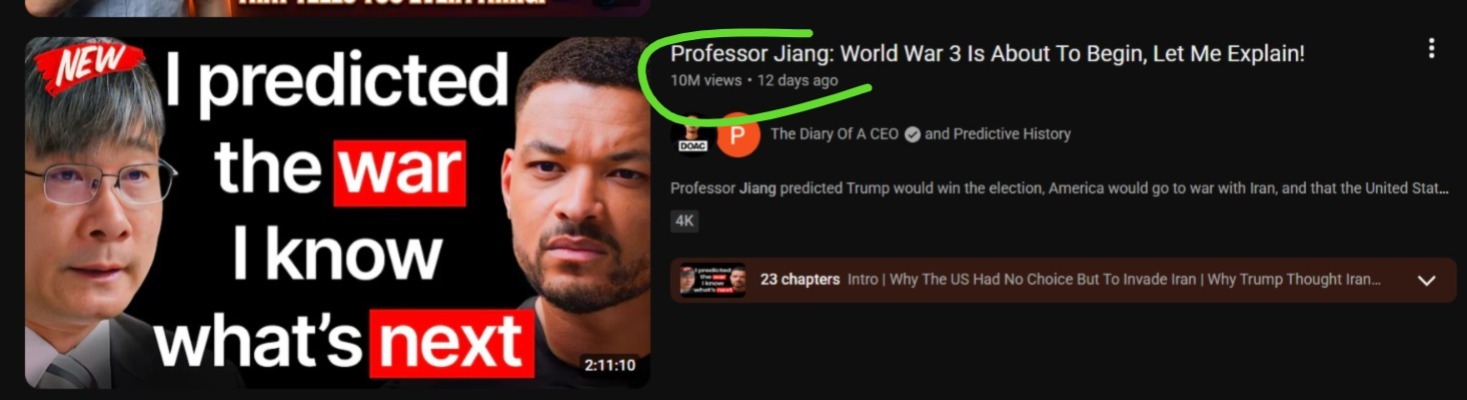
For followers of geopolitical analysis channels on YouTube, the scene has become familiar. Professor Jiang Xueqin, a philosophy teacher at Beijing’s Moonshot Academy, appeared in a lengthy episode of the podcast “The Diary of a CEO” on May 7, 2026, presenting a bleak yet methodically grounded vision he calls “Predictive History.” Within just seven weeks, the episode surpassed ten million views, transforming Jiang into a global media phenomenon. The audience’s curiosity was not driven by a love of abstract foresight, but by the fact that Jiang had recorded three bold predictions in a 2024 lecture: Donald Trump’s return to the presidency, the outbreak of an American war with Iran, and ultimately, that America would lose that war. With the first two already fulfilled, the public now anxiously awaits the third, and asks even deeper questions: what is this “World War III” that Jiang speaks of?
The Imperative of War: Why America Had No Choice but to Invade Iran
In the early minutes of the interview (02:11 – 28:00), Jiang explains the reasons that pushed the US administration, despite its awareness of the risks, into a direct military confrontation with Iran. He dismisses superficial explanations of “revenge” or “deterrence,” arguing instead that the decision stemmed from a strategic necessity related to dominating global energy markets. According to Jiang, Trump planned to impose American control over the Western Hemisphere (Venezuela, Canada, Mexico) to secure alternative energy sources. However, Iran’s growing influence in the Gulf and its direct threat to navigation in the Strait of Hormuz made confronting Tehran an “urgent priority that could not be postponed.” Trump believed Iran would collapse under aerial bombardment as Iraq did in 2003, but he was surprised by Iran’s “mountain fortress” and its ability to endure and transform the conflict into a prolonged war of attrition.
War of Attrition and the American Collapse Scenario
Jiang reveals that the war’s failure to achieve quick results will force the Pentagon into a ground invasion. He describes the American economy shifting from producing consumer goods to producing munitions, which will inevitably erode social welfare inside the United States. He predicts this path will lead to a humiliating withdrawal of US forces from the Middle East, closely resembling the 2021 Afghanistan withdrawal, but this time accompanied by a complete collapse of American influence in the region, leaving a vacuum to be filled by other powers.
Great Power Tactics: Russia, Israel, and China in the Shadow Game
Jiang offers a detailed analysis of the main players on the world stage. Regarding Russia (34:30 – 54:30), he believes Putin is pursuing an “attrition strategy” through a shadow fleet of oil tankers evading Western sanctions, and he predicts Moscow will intervene in support of Iran if the war drags on, not out of love for Tehran, but as part of a broader struggle against the West. As for Israel, Jiang argues its goals extend far beyond defeating Iran, reaching toward a “Greater Israel” project that exploits the gradual loosening of the American grip on the region. Finally, China – Jiang believes in a “secret deal” between Washington and Beijing, where China prefers not to replace the American empire, but rather to keep the United States bogged down in foreign wars while China continues its peaceful economic expansion. The likely deal, according to Jiang, would involve the US abandoning Taiwan in exchange for China not intervening militarily on Iran’s side.
Scenarios Inside America: A Third Term and a National Draft
Jiang’s pessimism is not limited to foreign affairs; it extends to the American domestic front, where he paints scenarios that some might find shocking (56:30 – 1:14:30). Jiang believes Trump will exploit a “state of war emergency” to cling to power and seek an unprecedented third term, bypassing the 22nd Amendment. He also predicts the Trump administration will impose a “National Draft” on American youth to compensate for the massive troop shortages resulting from what he calls “endless wars.” Even further, Jiang sees the world moving toward a complete transformation into a “digital surveillance state” that uses artificial intelligence to control human behavior, mimicking the current Chinese model, but under the justifications of national security and counter‑terrorism.
Who Pulls the Strings? The Philosophy of Reality and the Hidden War on Consciousness
In the deepest part of the interview (1:25:30 – 1:52:00), Jiang shifts from geopolitical analysis to political philosophy. Using Plato’s famous “Allegory of the Cave,” he explains how hidden financial powers (major central banks and the global banking elite) control the “shadows” that we perceive as news, politics, or conflicts. War, from this perspective, is not merely a military confrontation between nations, but a tool to direct collective consciousness and keep the masses occupied while wealth transfers and resource grabs occur in the shadows. Jiang believes we are living in a “hidden war” for hegemony over the human mind, and that politics is merely a facade for this deeper struggle.
The Human Conclusion: Love as a Final Lifeline
Just before closing the interview (2:04:00 – 2:10:50), Jiang suddenly steps away from all these gloomy scenarios to affirm that true salvation lies not in changing global policies, but in holding on to simple human bonds: family, love, and creativity. He admits that his wife saved his life from breakdown, and that his sense of belonging to his family is what gives him the strength to endure his dark vision of the world. In the end, Jiang leaves one message for those who fear the future: “Do not try to change the world; try to be a good part of it. Focus on what you can control: your relationships and your creativity.” This deceptively simple, profoundly deep statement may be what humans need most amidst the barrage of frightening news.
Sources & references:
The Diary of A CEO Podcast, episode with Professor Jiang Xueqin, May 7, 2026 – youtube.com
Jiang Xueqin, “Predictive History” YouTube channel and Substack newsletter
Various media reports: NDTV, WION, Express UK, Hindustan Times
Leave a Reply